
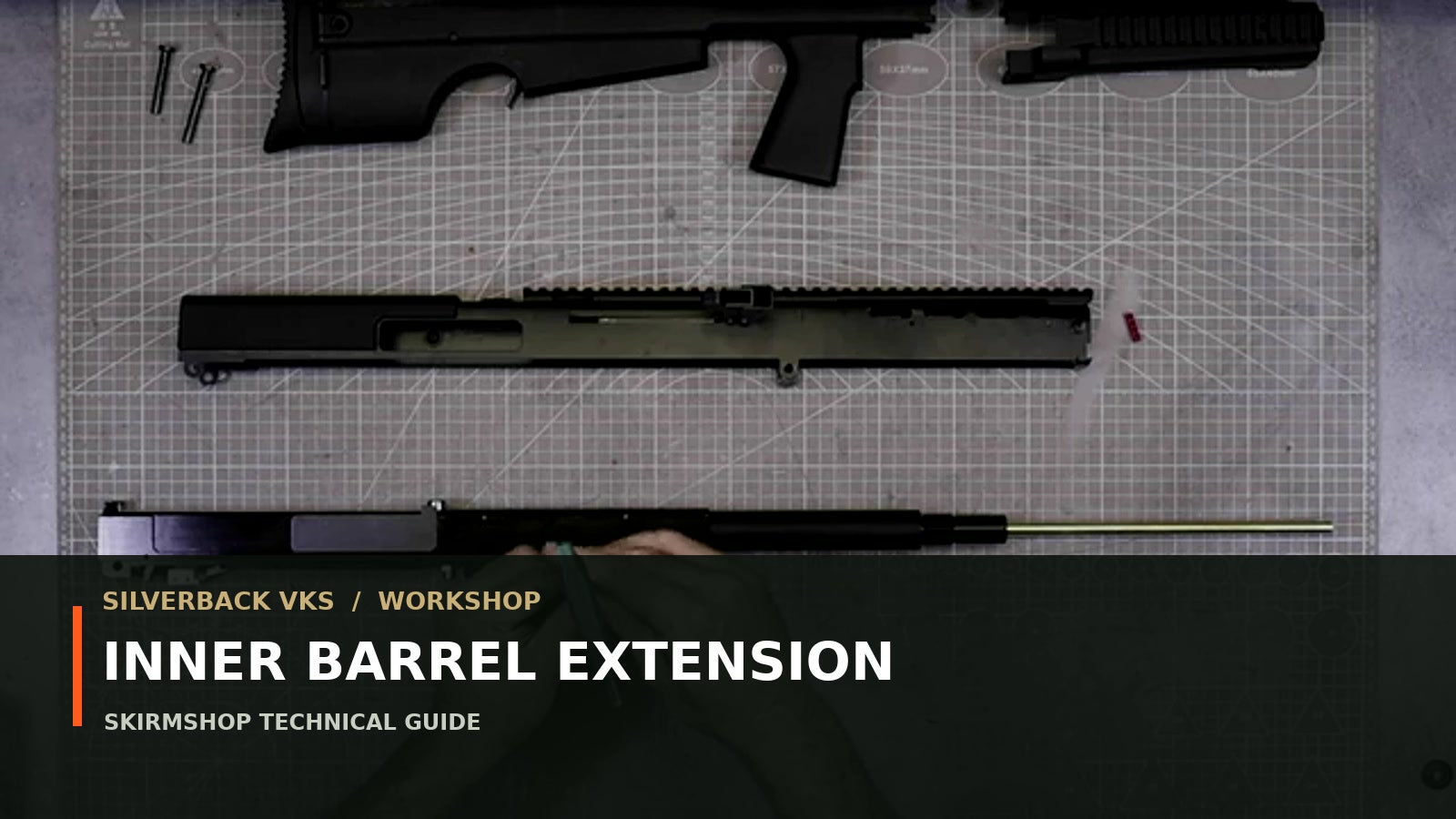

Official video workshop · 9:13
Silverback VKS inner barrel extension
A complete, workshop-ready version of Silverback's official procedure: barrel lengths, hop-up orientation, O-ring spacer positions, 4 Nm clamping torque and silencer reassembly in one place.
Before you start
What this modification changes
The VKS silencer can stabilise a longer inner barrel with barrel spacers. Silverback states a maximum stabilised length of 571 mm with the full-size suppressor and 467 mm with the half-size suppressor. The official example uses a 22-inch / 578 mm SRS inner barrel.
Tools
- 1.5 mm and 2 mm Allen keys
- Pin punch
- Torque wrench capable of 4 Nm
- Needle-nose pliers or a dedicated silencer tool
- Wooden push piece, correctly sized tube and rod
Parts and consumables
- Compatible SRS inner barrel
- 6 mm sacrificial spacer
- Two O-ring barrel spacers and suitable lubricant
- 20 mm silencer barrel spacer
- Original foam inserts, where legal
| Specification | Official value |
|---|---|
| Full-size suppressor | Up to 571 mm stabilised |
| Half-size suppressor | Up to 467 mm stabilised |
| Video example | 22 in / 578 mm SRS barrel |
| Receiver barrel clamps | 4 Nm |
| Hop-unit grub screws | Two M4; contact only, then very low and evenly distributed torque |
| Silencer spacer | 20 mm |
Primary source
Watch the official Silverback tutorial
This guide follows the official subtitles and footage. Use the video for hand position and visual alignment; use the written values below when a measurement or torque matters.
Procedure
Inner barrel extension, step by step
Field-strip the receiver
Drive out both assembly pins, remove the handguard and stock, lay the top cover on its side and slide the receiver out. Remove the red hop-up nub and keep it safe.
Remove the outer-barrel assembly
Loosen the four barrel-clamping screws, remove the barrel lock pin and slide the barrel out of the receiver.

Extract the inner barrel and hop unit
Use a 2 mm Allen key to remove the two outer-barrel set screws. Push the inner-barrel/hop assembly out with a piece of wood, then remove the two O-rings that act as barrel spacers.
Transfer the hop components
With a 1.5 mm Allen key, remove the two screws retaining the inner barrel. Remove the hop unit, bucking and O-ring. Refit the O-ring and bucking to the new barrel, then slide them into the hop unit in the same orientation.

Set the two hop-unit screws without crushing the barrel
Insert a 6 mm sacrificial spacer to protect the inner barrel. Turn both screws only until they touch, then distribute a very low tightening force evenly. Remove the spacer: if it will not come out, the screws are too tight.
Align the hop unit and position both O-rings
Slide the assembly into the outer barrel and align the hop window with the barrel window. Install the two M4 grub screws; the upper screw self-centres in the hop unit's top groove. Lubricate the O-rings, push the first to the centre of the outer barrel with a tube and leave the second at the muzzle.

Open the silencer
Loosen the three muzzle nuts without fully removing them. Remove the muzzle and push out the foam inserts with a correctly sized rod. A dedicated tool is preferable; Silverback also demonstrates needle-nose pliers.
Refit the barrel to the receiver
Insert the barrel with the hop unit correctly oriented, reinstall the lock pin and tighten all four barrel-clamping screws to 4 Nm. Install the nub with its concave side facing the bucking.
Close the VKS without forcing the pins
Slide the receiver into the top cover while watching the dust cover. Install the stock with the selector on FIRE, then the handguard. Insert the long front pin and short rear pin by hand—never with a hammer.
Stabilise the barrel inside the silencer
Screw the silencer to the outer barrel. Use a purpose-made tool to push the 20 mm barrel spacer into the silencer base. Reinsert the foam elements in an alternating small-hole / large-hole pattern, engage the muzzle and moderately tighten the three nuts.

Avoid these errors
Critical checks
- Do not exceed “very low” torque on the two hop-unit screws; the removable 6 mm spacer is the check.
- Do not reverse the nub: its concave face belongs against the bucking.
- Do not swap pin positions: long at the front, short at the rear.
- Do not hammer the assembly pins.
- Do not leave both O-rings together; one is central and one is at the muzzle.
- Do not claim the whole 578 mm example is stabilised: Silverback states 571 mm as the full-suppressor stabilised limit.
FAQ
VKS inner barrel extension questions
What is the longest stabilised inner barrel for the VKS?
Silverback states 571 mm with the full-size suppressor and 467 mm with the half-size suppressor.
Why does the official video use a 578 mm barrel?
The video demonstrates a 22-inch / 578 mm SRS barrel, while separately stating a 571 mm stabilised capacity for the full suppressor. The extra length should not be described as spacer-supported.
How tight should the four receiver clamps be?
Use 4 Nm on each of the four barrel-clamping screws.
How tight should the two small hop screws be?
Silverback does not give a numeric torque. Bring them into contact and distribute a very low force evenly. If the 6 mm sacrificial spacer cannot be removed, they are too tight.
Which way does the hop-up nub face?
The concave side faces the hop-up bucking.
Does a longer barrel automatically increase power?
It changes the pneumatic setup and may let you use a weaker spring for the desired output, but the result depends on the complete build. Chronograph after the change and tune to your field limit.
Share:
La mochila del sniper novato: qué llevar y qué dejar fuera en una partida de airsoft
Silverback VKS Right- / Left-Hand Conversion Guide